
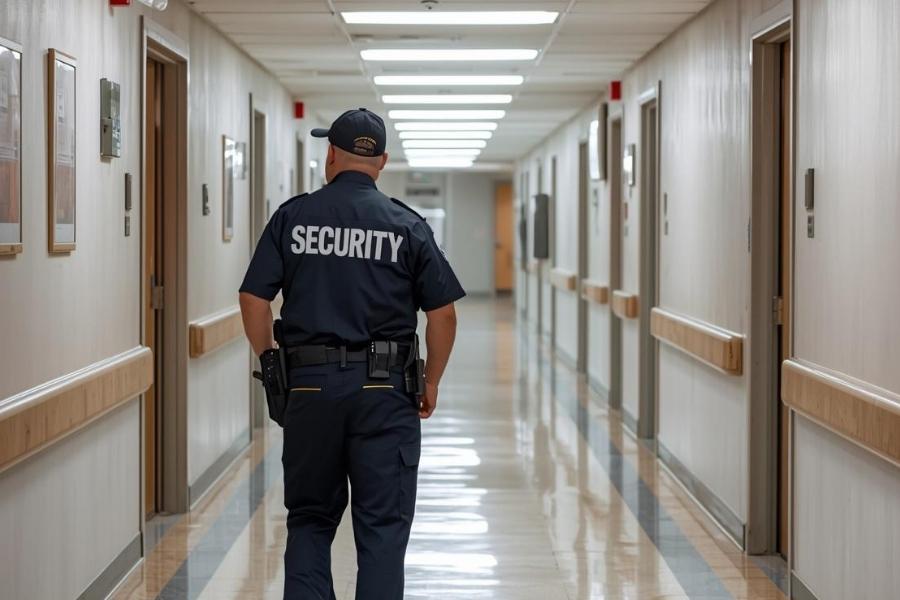
Code White incidents, involving aggressive or violent patients or visitors, have increased by over 40% in Alberta hospitals since 2019, according to Alberta Health Services. Healthcare workers are now more likely to be assaulted at work than police officers in some AHS data categories. Trained healthcare and hospital security guards in Edmonton are no longer optional, they are a frontline staff safety requirement.
Why Healthcare Security Is Different From Standard Security
The Patient Population
Security guards in healthcare settings regularly interact with patients who are in pain, under the influence of medications or substances, in psychiatric crisis, or experiencing extreme emotional distress. A hospital security guards must be trained in de-escalation, mental health first aid, and trauma-informed communication — skills that go well beyond basic guard certification.
24/7 Open-Access Environments
Most hospitals in Edmonton operate on a 24-hour basis with public access requirements. hospital security guards is about managing access intelligently, not restricting it broadly. Guards must understand how to balance security requirements with the care environment.
FOIP and Patient Privacy
Healthcare security guards operate within environments governed by Alberta’s Freedom of Information and Protection of Privacy (FOIP) Act. All Alpine guards assigned to healthcare environments receive a FOIP orientation specific to healthcare settings. For more on guard training standards, see how Alpine trains security professionals.
Common Security Scenarios in Edmonton Healthcare Facilities
Emergency Department Violence
Edmonton’s emergency departments — Royal Alexandra Hospital, University of Alberta Hospital, Grey Nuns Community Hospital, and the Misericordia Community Hospital — are among the highest-incident areas in the city for security events. Trained guard presence at triage, waiting areas, and secure entry points is essential.
Psychiatric Unit Access Control
Access to inpatient psychiatric units requires strict control. Alpine’s access control guards for restricted areas in Edmonton perform authorized entry verification, visitor management, and restricted zone monitoring, preventing unauthorized access and reducing patient elopement risk.
Parking Lot Security
Hospital parking lots are high-volume, 24-hour environments with significant vehicle crime rates in Edmonton. Alpine’s mobile patrol security services for healthcare parking areas include randomized overnight checks, parking garage sweeps, and immediate response to reported vehicle incidents, protecting staff working overnight shifts.
How Alpine Trains Their Hospital Security Guards In Edmonton
• Mental Health First Aid (MHFA) certification — approved by the Mental Health Commission of Canada
• De-escalation techniques specific to healthcare settings: verbal diffusion, non-confrontational positioning, exit coaching
• FOIP orientation: what healthcare-related personal information looks like and how to handle accidental exposure
• Code White response protocols: alerting clinical staff, containing the situation, supporting medical team response
• Trauma-informed communication: interacting with patients in acute distress without escalating the situation
Security Services for Different Healthcare Settings in Edmonton
| Setting | Recommended Service | Key Focus Area |
| Large Hospital (Royal Alex, U of A) | Multiple static guards (ED, main lobby, parking) + mobile patrol | Code White response, ED access control, parking |
| Community Hospital | 1–2 static guards (lobby + parking) + after-hours patrol | After-hours access, parking lot security |
| Walk-In Clinic | Static guard during business hours + alarm response after hours | Patient disturbance, after-hours protection |
| Mental Health Facility | Dedicated static guard at entry + interior patrol | Patient elopement, visitor control, de-escalation |
| Pharmacy (standalone) | Overnight static guard (high-risk locations) | Controlled substance theft prevention |
Alpine’s full healthcare security guard services for Edmonton are available for hospitals, clinics, pharmacies, dental offices, and mental health facilities across the city and surrounding areas. Contact us to discuss deployment requirements for your facility.
Frequently Asked Questions — Healthcare Security in Edmonton
Q: What is a Code White incident, and how does a security guard respond?
A: A Code White is the standardized hospital code for a violent or potentially violent person. Trained security guards respond to the location, establish a containment perimeter with clinical staff, use verbal de-escalation as the first intervention, and only escalate to physical intervention as a last resort under clear threat of harm.
Q: Are your healthcare guards trained in de-escalation?
A: Yes. All Alpine guards assigned to healthcare environments receive Mental Health First Aid certification and specific de-escalation training. This is a condition of assignment, not an optional add-on.
Q: Can a security guard legally detain a patient in a healthcare facility?
A: Security guards in Alberta have the same powers of arrest as any citizen under Section 494 of the Criminal Code of Canada. They cannot detain patients against their will for clinical reasons — guards can physically intervene to prevent violence or serious harm.
Q: Do you work with existing nursing and clinical staff security protocols?
A: Yes. Before beginning any healthcare deployment, Alpine’s supervisors meet with the facility’s manager to review existing protocols and ensure our guards integrate seamlessly with the existing team.
Q: How do you handle FOIP compliance for guards working in patient areas?
A: All Alpine guards assigned to healthcare facilities receive a FOIP orientation. Guards are trained not to record, reproduce, or discuss any patient information they may incidentally encounter in the course of their duties.